When Dr. Herbert Tanenbaum helped establish Washington, D.C.’s first cardiac catheterization laboratory, the equipment cardiologists take for granted did not exist.
Tanenbaum needed a wire thin and flexible enough to guide a catheter through an artery. His solution was low-tech: He went to a music store and bought guitar G-strings.
“The storekeeper would say, ‘You must be a terrible guitarist,’” recalled Tanenbaum’s son Mark, himself a cardiologist. “Because you keep breaking the same G-string.”
The strings were sterilized in an autoclave and used until they lost their elasticity.
That blend of medical ingenuity, curiosity and practicality characterized a career that began when modern cardiology was still taking shape.
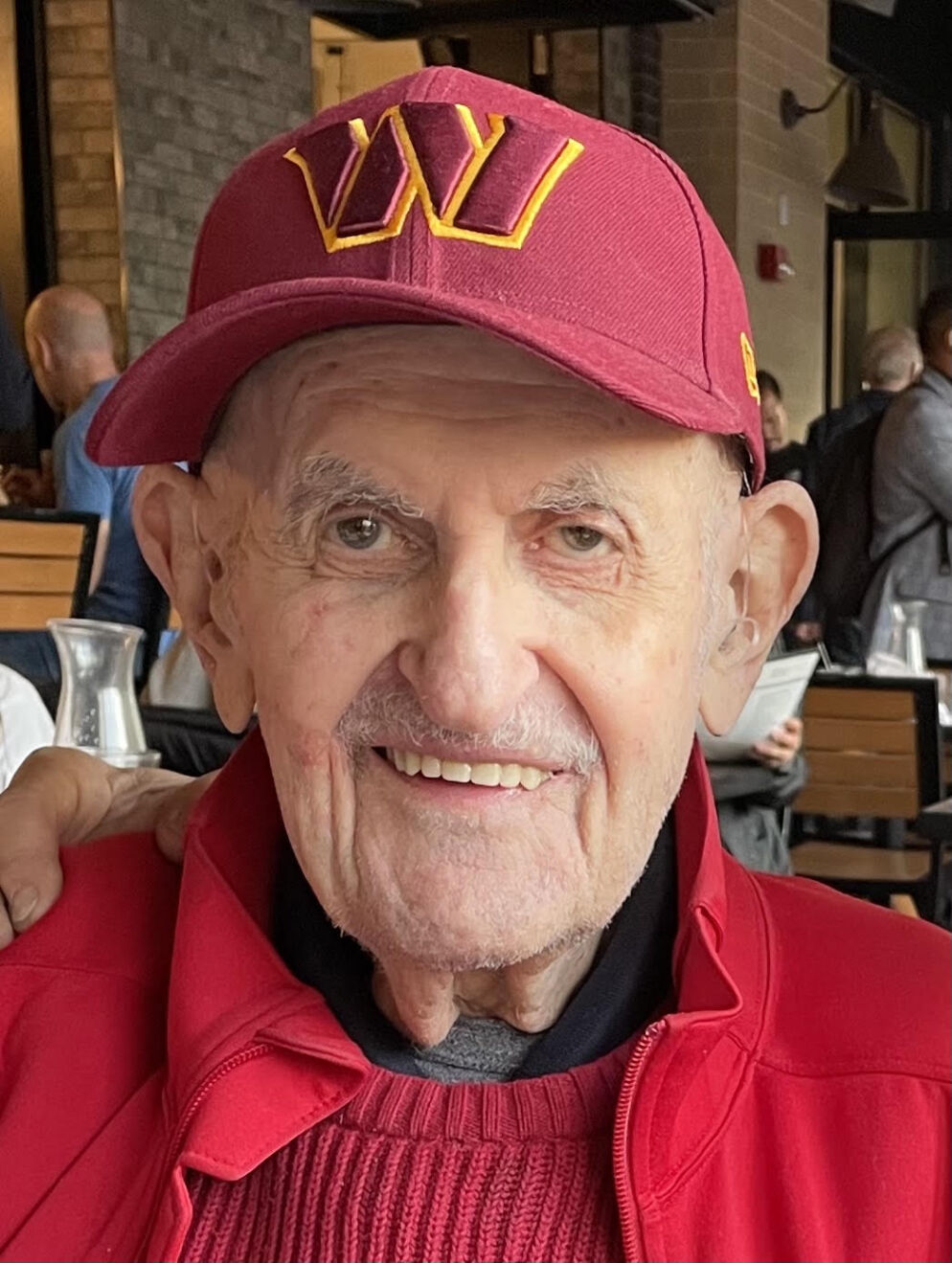
Dr. Herbert Tanenbaum, a Washington native, cardiologist and longtime member of Congregation Beth El of Montgomery County, died Aug. 20. He was 98.
Born Oct. 20, 1927, Tanenbaum was the youngest of four children of Sam and Tessie Tanenbaum. His parents had moved from New York to Washington in 1921 after a relative lent them money to open a grocery store.
Tanenbaum’s childhood was spent living above the family store near First and Thomas streets NW. He delivered groceries, watched the iceman and watermelon seller travel the neighborhood by horse and buggy and helped prepare chickens for sale.
Medicine became Tanenbaum’s ambition early, carrying him to Georgetown University.
Getting into medical school was another matter.
Although an outstanding student, Tanenbaum encountered the Jewish quota system then common at American medical schools. He applied to many schools but was accepted only at Georgetown after a professor advocated for him.
“He was the last person to get into my class,” Mark Tanenbaum recalled his father saying.
Four years later, Tanenbaum graduated valedictorian of Georgetown University School of Medicine’s class of 1952.
After internships and residency training in Boston, Washington and New Orleans, he joined the National Institutes of Health in Bethesda in 1955. He initially considered nephrology, but the research laboratory used chickens. The smell reminded him vividly of slaughtering chickens at his parents’ grocery store.
“He walked down the hall and found the cardiology department,” Mark Tanenbaum said. “He was one chicken away from becoming a nephrologist versus a cardiologist.”
At NIH, Tanenbaum trained as cardiology was emerging as a specialty. Mark said his father and his colleagues helped establish research foundations that influenced generations.
He entered clinical practice in 1958 rather than accept offers for academic positions because he wanted to remain in Washington and raise his family there.
At Washington Hospital Center, Tanenbaum established its cardiac catheterization laboratory and, according to Mark Tanenbaum, performed the first cardiac catheterization in Washington.
He became known as an exceptional diagnostician and an assistant professor of medicine at Georgetown.
“If somebody couldn’t figure something out, they would often send it to my father,” Mark Tanenbaum said.
Patients remembered something else: his warmth.
Steven Tanenbaum recalled a patient who could not afford his father’s fee and instead paid him with fresh chickens and eggs.
When Tanenbaum brought them home, his wife, Elaine, reminded him that he was one of the country’s leading cardiologists.
Tanenbaum observed that the food looked especially fresh.
“He was one of the sweetest, easygoing men you ever wanted to meet,” Steven Tanenbaum said.
Tanenbaum served as president of several medical organizations, including the Jacobi Medical Society, Washington’s Jewish physicians’ organization, and was active in the American College of Cardiology. In 2013, the Maryland chapter presented him with its Presidential Citation.
He also chronicled encounters from his career in a 96-page paperback, “Out of the Doctor’s Bag,” published in 2011 by Beckham Publications Group.
Judaism remained central throughout his life.
Raised in a kosher household, Tanenbaum grew up speaking Yiddish and traveling by streetcar to Hebrew school. His father was observant and attended synagogue regularly.
As an adult, Tanenbaum and his wife, Elaine, raised their five sons in a Conservative Jewish home and became involved at Beth El. After Elaine’s death in 2007, his involvement intensified. He attended services, served on the synagogue board and continued participating by Zoom as age made attendance more difficult.
Even in assisted living, his daughter-in-law Claire Tanenbaum said, he would put on his tallit and kippah for Shabbat services.
He was also active for decades at the Jewish Community Center in Rockville, where he helped establish and advise a cardiac rehabilitation program.
Passover held meaning. Because Tanenbaum had been the youngest child in his own family, he continued reciting the Four Questions well into old age — eventually doing so in Hebrew, Yiddish and English for children and grandchildren gathered around the seder table.
Outside medicine, he loved jazz, gardening, fishing and Washington sports. He remained curious long after retiring from practice in 1994 and regularly attended medical conferences.
Above all, his sons said, he valued education, family and doing one’s best.
Mark Tanenbaum remembers his father telling his sons that it did not matter whether they became a garbage collector or president of the United States.
Whatever they chose, he told them, they should strive to be the best at it.
Tanenbaum had 16 grandchildren and lived to see another generation of the family he cherished.
Mark said what he will miss most is his father’s storytelling — even the stories the family had heard countless times.
“He told it as if it was the very first time anybody would hear it,” Mark said. “And at the end of the story, he would laugh because he enjoyed his stories himself.”
Ellen Braunstein is a freelance obituary writer. She welcomes suggestions for individuals who had meaningful ties to the greater Washington Jewish community. Email csix@midatlanticmedia.com.