The 50-year-old Maryland School for Jewish Education is Montgomery County’s “best-kept secret” in Jewish education, according to MSJE Director Eric Manne.
Housed in Rockville at the Bender JCC of Greater Washington, MSJE is a nonprofit organization that aims to provide Jewish learning to families who seek it for their children.
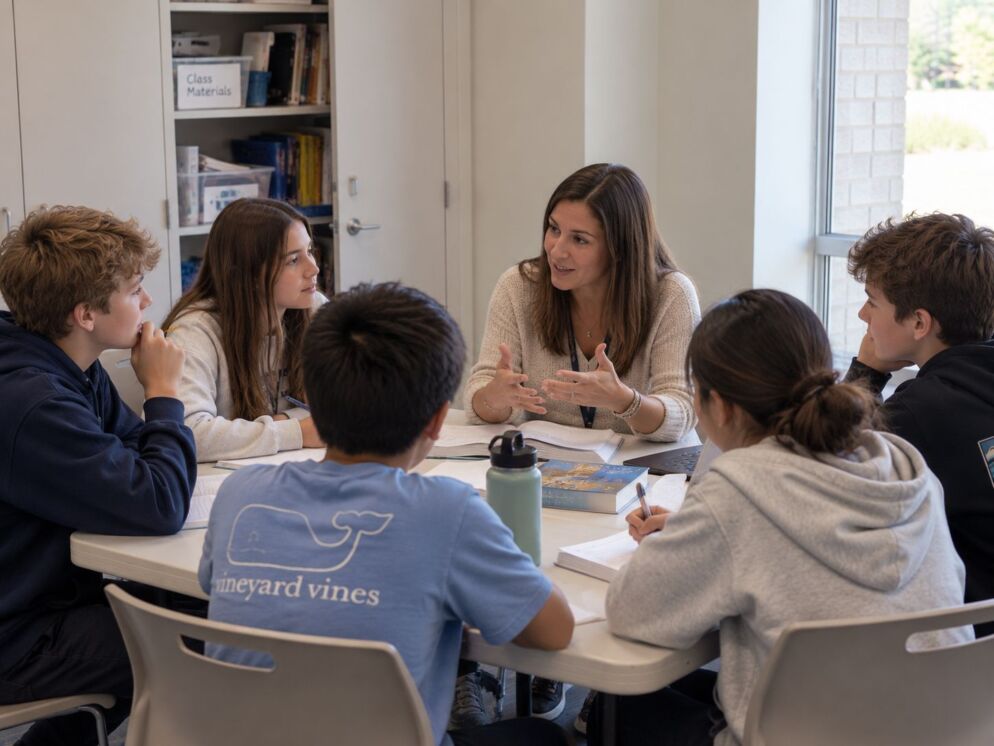
MSJE uses a project-based curriculum on Sunday mornings to engage students in kindergarten through seventh grade and get them moving.
“They’re doing activities rather than the typical pedagogy, where there’s a teacher lecturing to them,” Manne said. “[For] the younger grades, we use Hebrew Through Movement, the general thesis that kids learn by hearing.”
Native speakers of any language typically don’t initially learn through reading and text. Instead, language is picked up as a baby through listening and identifying words with something.
Teachers lead a game similar to “Simon Says,” where students may be asked to move “up” or “down” when the teacher says the Hebrew translations of those words. Once they understand the basics, commands get more complex, such as, “Go to the blue chair in the corner.”
“It’s a way to get the kids moving and having fun in the classroom … so they’re learning without learning,” Manne said. “We’re very big on crafts and activities.”
A classroom favorite is the Chocolate Seder every Passover.
Though Manne described MSJE’s approach as “camp-like without the kids actually being at camp,” there’s also time for traditional learning.
“As the kids learn and are creating the logic — they are working on [Hebrew] language with worksheets and textbooks,” Manne said. “Through the decoding, they’re starting to then put the words together and the sounds and letters so that they become better able to read and become familiar with the language.”
Celia Barash, MSJE’s program manager, consultant and b’nai mitzvah coordinator, made a list of Jewish prayers students should know, including “Ma Tovu” and “David Melech Yisrael” for the younger kids.
The teachers, who lean Reform in nature, sometimes show YouTube videos and movie clips — a snippet of “You Are So Not Invited to My Bat Mitzvah” facilitated a class discussion around the Jewish teen rite of passage.
Students also learn about Jewish values — tikkun olam and mitzvot — by doing an activity or project related to that concept. In addition to learning, Barash said she hopes MSJE students leave the classroom with a stronger sense of Jewish identity.
“That doesn’t necessarily mean religious identity, but the identity that ‘I’m a Jew,’” she said. “‘I have a purpose in being a Jew to give to the world, do good deeds, share our knowledge, be mediators sometimes in conflict, and pass it on to the next generation: l’dor v’dor.’ … I think it’s really important, today especially.”
The Hebrew school isn’t affiliated with a synagogue, making it a rarity in the Jewish community.
Many Jewish families want their kids to gain Hebrew education, but may not be able to afford synagogue dues, which range from the hundreds to several thousand dollars annually. MSJE tuition ranges from $1,525 to $1,925 for an academic year, and is discounted for siblings and Bender JCC members.
“[Jewish education is] important to people,” Manne said. “They want to have a place to go for the High Holidays and for their children to be b’nai mitzvahed, but they’re not looking for the full synagogue experience.”
Some others may not be DMV residents for good.
“The D.C. area is transient,” Manne noted. “People move here for jobs for several years and move back, so belonging to a synagogue may not fit with what they’re looking for long term. And we fit that niche.”
He said MSJE meets families where they are, including families who are interfaith and those with various levels of Jewish observance.
“It’s very open that way,” Barash said.
Manne, “the Jewish half” of an interfaith marriage, was searching for a synagogue when he discovered MSJE through its free community High Holiday services. After visiting, he learned MSJE was a Hebrew school.
Manne spent time volunteering at the school, where he saw “smiles on [students’] faces and them having connections with their teachers and other students.” Small class sizes and a staff team of eight mean that the school community is more intimate than a larger Hebrew school environment, Manne said.
His own two children attended MSJE.
“The way [my daughter] was able to chant the prayers in Hebrew and lead [her bat mitzvah] service was amazing,” Manne said, adding that his son would go around the house singing bits of Jewish prayers “out of the blue” during the time he had a tutor through MSJE.
Beyond the b’nai mitzvah, MSJE graduates can return to the school to serve as classroom aides.
“Even now, they’ll ask periodically insightful questions about religion or something tangential to it, but I can tell there’s still the influence of what they learned in Hebrew school that’s coming behind the question,” Manne said.
zbell@midatlanticmedia.com