
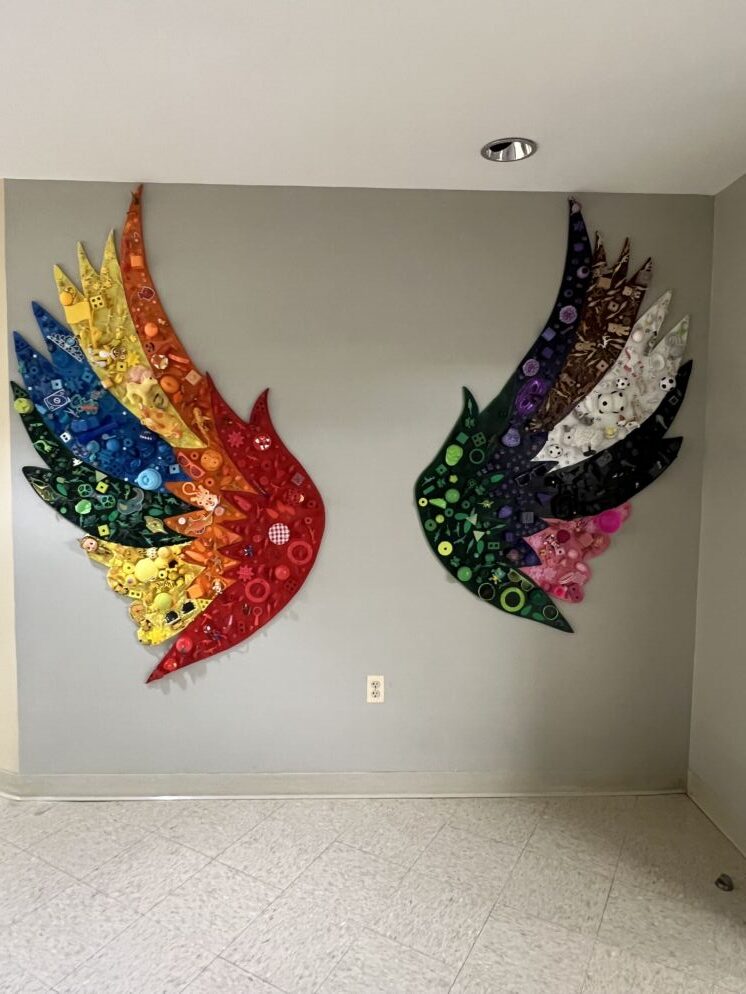
The piece “Wings of Hope” was originally created by the late artist Livnat Kutz in southern Israel in July 2023. Made up of old, recycled plastic toys gathered from her community, the artwork adorns the wall of a bomb shelter in kibbutz Kfar Aza.
Now, a version of the piece is displayed at a Potomac shul.
It’s inspired by Kutz’s colorful creation, made just months before she, her husband and three children were killed on Oct. 7, 2023.
“Since then, the community of Kfar Aza continued their story, and one [way is] to bring Livnat’s wings all over the world,” Inbal, Congregation B’nai Tzedek’s shlicha, told Washington Jewish Week. “Once I saw this project, I decided that I had to bring it to B’nai Tzedek and the Jewish community here in the DMV.”
She described the creation of the piece as a collaborative project. First, Inbal reached out to the B’nai Tzedek community, communities around the DMV, the Israeli community and fellow shlichim to collect unwanted toys beginning before Passover.
Inbal worked with Charlie Greenblatt, the religious school art teacher, to trace wing shapes onto two pieces of plywood and cut them out with a circular saw. They sketched out sections of the “wings” for different colors, which the religious school students painted, along with preschool families and adults in the B’nai Tzedek community.
“[The adults] heard about this project, brought their toys and said, ‘How can we help?’” Inbal recalled.
The religious school students helped sort the toys and objects by color after learning about Kutz’s story. Adults glued the toys onto the plywood wings, led by Greenblatt, concluding an effort that spanned a month and a half.
In addition to teaching teamwork and creativity, creating “Wings of Hope” was also a lesson in sustainability. “This shows the kids that even though you’re not using something, maybe you can use it for a different thing,” Inbal said.
The project was made possible with the help of the Langfan Israel Fund, which was established by two community members to promote Israel-related activities at B’nai Tzedek.
“Thanks to their help, we managed to make this project bigger than we thought,” Inbal said. “So it was really a community-wide project. Every group of the community helped make this dream [come] to life.”
The finished piece hangs in the social hall of B’nai Tzedek’s Greenzaid Early Childhood Center, “so the kids can see their project, stand next to the wings and feel like they have their own wings of strength and hope and resilience,” Inbal said.
That message is pertinent to the shlicha, who is Israeli.
“It’s really important to me to bring the story of Oct. 7 here,” she said. “The Jewish community in the Diaspora and Israel are united in one big community, and I wanted to bring the story of Livnat and the kibbutz Kfar Aza community to B’nai Tzedek.”
A plaque next to the art piece memorializes Kutz and her family.
Kutz originally made “Wings of Hope” as part of art therapy for the kibbutz, located near Israel’s border with Gaza. She brought art projects to children and families at Kfar Aza who were traumatized by ongoing attacks.
“I want people to know that even though unfortunately she’s no longer here, her spirit and her hope and her education and her ideas and everything she did with the community still continues,” Inbal said.
B’nai Tzedek’s “Wings of Hope” is a burst of color, reminiscent of childhood. Featured items include kids’ sunglasses, puzzle pieces, plastic figurines, an Uno card and building blocks.
Inbal’s favorite is a small toy elephant, which she said reminds her of Kfir Bibas, the youngest hostage kidnapped on Oct. 7. The 9-month-old was killed in captivity along with his 4-year old brother, Ariel, and mother, Shiri Bibas.
“One of his famous pictures is him holding a little toy, [a pink elephant plush toy], and it reminds me of Kfir Bibas,” Inbal said of the elephant toy. “That reminds me also [of] the trauma that we had since Oct. 7, and that every little thing — even a small toy elephant — reminds us of the pain of that day, but shows the hope that we still have kids here to educate and raise … That was the toy that I most connected with.”
Inbal expressed gratitude to B’nai Tzedek and the wider Jewish DMV community for their support, advice and toy donations.
“I just want to say a huge thank you, and I also want to encourage more communities to make this art piece because it’s really beautiful and has such a big meaning,” she said.
zbell@midatlanticmedia.com


