
Pour three glasses of pinot noir side by side, one from Burgundy, one from Sonoma Coast, California and one from Central Otago in New Zealand, and you will not need a wine education to know that something is different in each glass. Same grape, three wines that taste nothing alike. The Burgundy tends toward earth and dried cherry and a certain restraint. The California is riper and rounder, fruit forward in a way the French bottle never is. The New Zealand is darker and more perfumed, with an acid line that keeps it lifted.
None of that comes from the grape. It comes from where the grape grew. Limestone or volcanic soil or river gravel, the number of cold hours a vine gets in winter, how much rain falls and when, how far the temperature drops after a hot afternoon, how much water the wind and sun pull out of a leaf in July. Those things decide how slowly the fruit ripens and how much acid survives the ripening, which is most of what you are tasting. That is what the word terroir means: climate and dirt and elevation, expressed through a vine. Wine regions earn their names by being reliably different in that way. Burgundy, Bordeaux, Chianti, Rioja, Napa. The name on the bottle is a promise that the wine inside came from a place with describable conditions, and a serious wine country puts that promise in writing. Israel, until two weeks ago, had not.
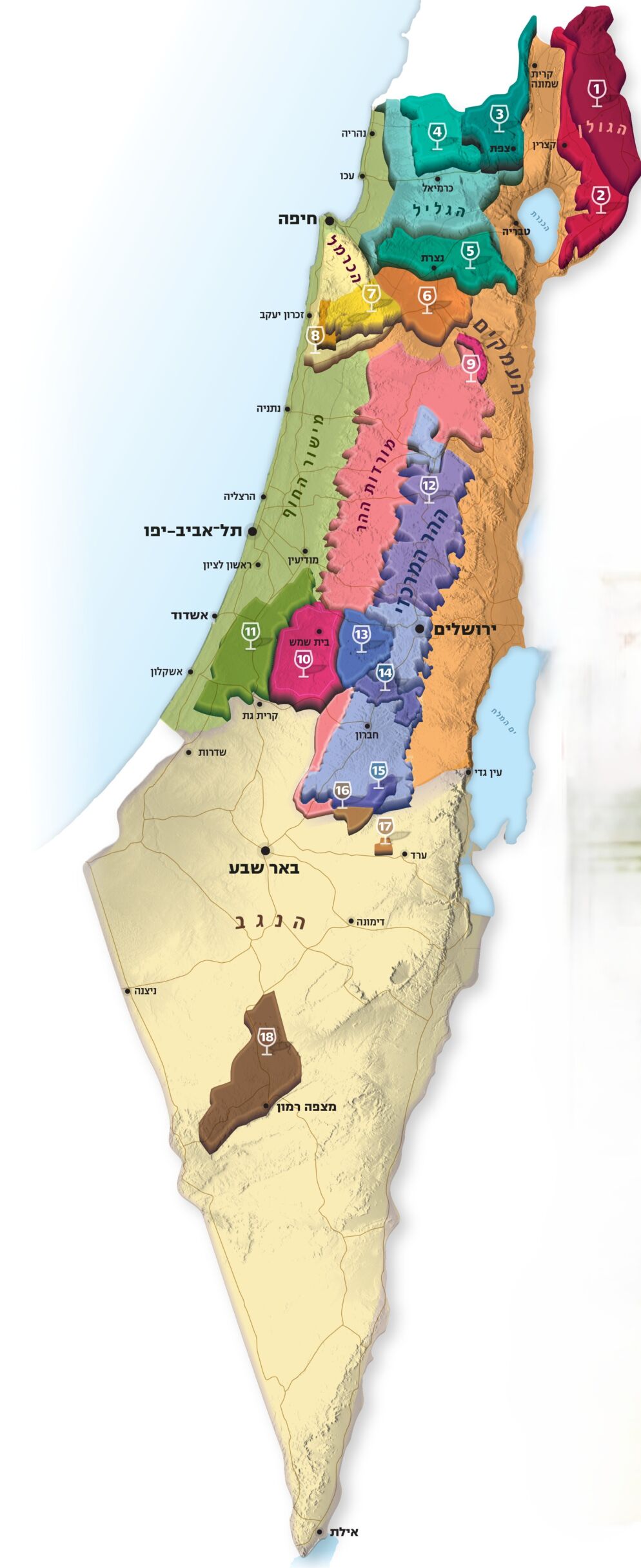
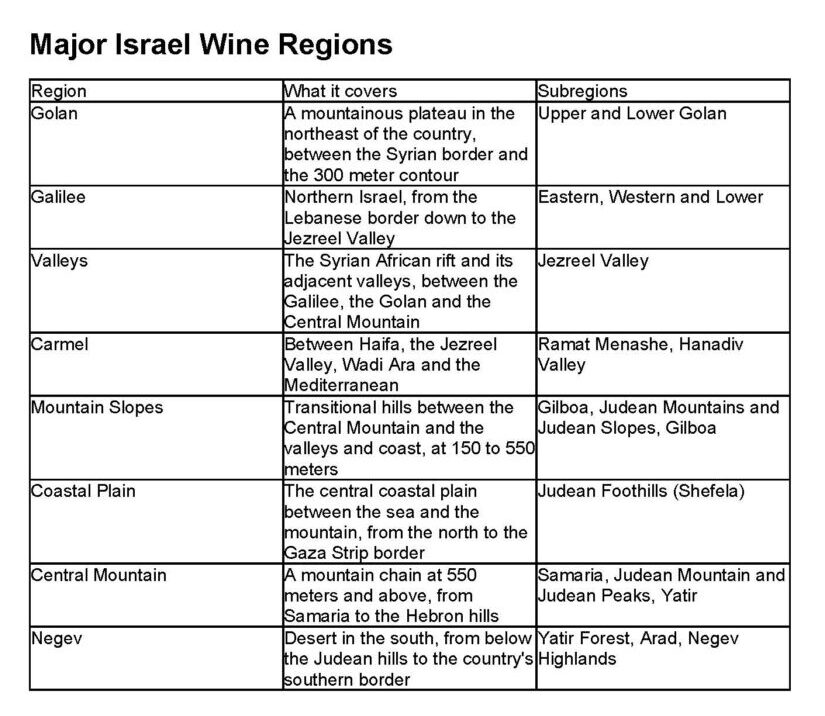
On Sept. 6 in Rishon LeZion, it did. The Ministry of Health, the Ministry of Agriculture and Food Security and the Israel Wine Grape Council jointly published Israel’s first official map of wine-growing regions, dividing the country into eight regions with 18 subregions nested inside them.
If a winery wants to put one of those names on a label, at least 85% of the grapes in the bottle must come from that place. The same 85% applies to naming a grape variety or a vintage year. You may not name two growing areas on one wine. And there is a fallback: miss 85% for a subregion but clear it for the super region above, and you may use the super region name.
Nobody is required to use any of it. The presentation is blunt about this: the choice to label a specific growing area is entirely voluntary, and the recognized and lawful default remains “Israeli wine.” Any winery that labels a region must keep an origin-proof file: vineyard records, harvest notes and intake certificates.
Of note is the way the map handles Yatir Forest, the largest planted forest in the world and home to the prestige Yatir Forest Winery and vineyards. Although Yatir is technically in the Negev, it’s a very different terroir than the sandy Negev and thus has its own subregion to indicate the distinction.
Per-region profiles were released alongside the map, and they answer the skeptic who asks what difference geography can make in a country you can drive across in a day. The Upper Golan gets 650 to 1,200 millimeters of rain and 800 to 2,500 chilling hours, on basaltic lithosols. The Negev Highlands get about 50 millimeters, on rock outcrops and loess, with 700 to 1,800 chilling hours at elevation. The Arad Valley gets 100 millimeters, and the sheet notes that its extreme daily temperature swing is what preserves acidity in the grape. Burgundy to Otago is a long way to travel for that kind of contrast. Israel does it in four hours on Route 6.
What 85% does and does not buy you
The threshold is standard. Most American appellations use it — California allows 85% for an AVA and 75% for a county designation — and the logic is the same everywhere: an appellation describes where the fruit grew, not where somebody pressed it. Herzog is the obvious example on our side of the ocean, making excellent Napa, Sonoma, Lake County, Clarksburg and Paso Robles wines in Oxnard, hundreds of miles from the vineyards. If a winery is not estate bottling, provenance of fruit is the honest thing to regulate. But it does mean the map promises less than the launch coverage suggested. Consider Nana, which grows all its own fruit in the Negev but has no winery of its own. Those wines are made far to the north at Pelter and Matar. Under the map, they are Negev wines, and by the standard everyone else uses, they should be. Just understand that “Negev” on that label is telling you about dirt and sunlight, not about a place where wine is made. Contrast this with Spain, where producers like Elvi must source grapes and produce the wine within the specific designated region for wines like Montsant, Priorat, Rioja and Cava.
Not finished, and not meant to be
A subregion needed two things to make the cut: at least 500 dunams planted, and a character that can be described. The teams who worked on the map will reconvene after the chagim to define additional subregions, and the intent is that it be petitioned for by growers and winemakers. Ella Valley within the Judean Foothills is the obvious candidate. Kadesh Valley in the Galilee is another. This is how Burgundy got its village and vineyard hierarchy too, over centuries, from people who farmed adjacent slopes and insisted the wines were not the same.
However, the map does not create a European system with permitted varieties, yield caps, or minimum aging. Israel’s modern industry is about 50 years old and still working out which grapes belong where. California, with its flexibility and room for innovation, is the model, rather than the strict rules of France or Italy.
The ministry is also building the tools to check its own numbers. Together with the Volcani Institute and Ben Gurion University it has developed a remote sensing and artificial intelligence model that distinguishes wine grapes from table grapes, tested with the Wine Grape Council, with a first output already available.
I asked a number of winemakers what they made of it. They all landed in the same place: a good first step. I think that is right. The numbers are real, the criteria are defensible, and for the first time a wine drinker can look up what an Israeli label is claiming and find a definition behind it. But today, a wide range of grape varieties are grown all across Israel, often without regard for whether the local terroir is best for that grape. The kosher market demands Cabernet Sauvignon, making it the most planted grape in Israel despite the warm climate that often favors varieties such as Syrah, Roussanne, Grenache and Marselan. There are some very fine producers of Cabernet Sauvignon, but many other wineries will need to demonstrate success with grapes that best represent their specific region for Israel to truly gain acclaim for its wine regions. Nevertheless, a map is where the conversation starts.
Jules Polonetsky is a Wine and Spirits Education Trust Level 3 certified wine expert who edits a wine education website at kosher-wine.org.


