
Fran Kritz
My overriding thought after seeing a preview of “Looking UP,” a new documentary that will be screened at the Annapolis Film Festival on Sunday, was ‘What challenges should I try?’ I think everyone who sees the film will start their own list.
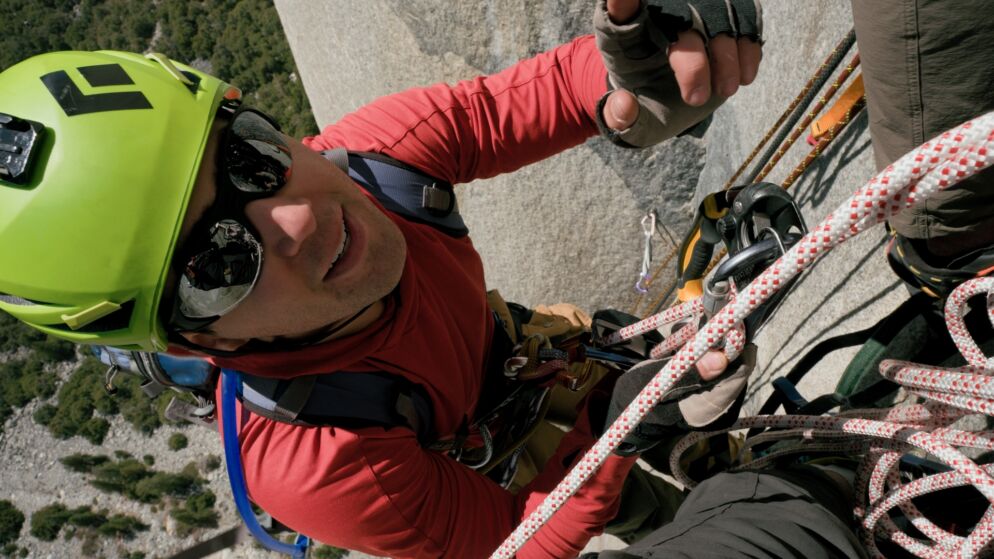
“Looking UP” follows Eitan Armon, 28, raised in Kemp Mill, Maryland, as he and two companions, an experienced rock-climbing guide and a friend’s avid mountaineering father, climb El Capitan, the iconic 3,000-vertical-foot granite rock formation in Yosemite National Park. What makes Armon’s climb exceptional is that he is legally blind with severely limited vision. “Within our limitations,” said Armon, “we can still have meaningful, fun and challenging lives. Let go of what you can’t control and focus on what you can.”
In Armon’s case, letting go includes leaving terra firma, sleeping on a portaledge tethered to the side of El Capitan and hovering thousands of feet in the air. He and his companions originally planned to do the climb in three days, but some unanticipated challenges led to an additional cold and stressful 28 hours on the wall — all of which is documented on camera.
Armon’s family are members of the Kemp Mill Synagogue and Eitan (and his sisters) attended the Hebrew Academy of Greater Washington (now Berman Hebrew Academy) and Charles E. Smith Jewish Day School. He then attended a premilitary academy in Israel and served in the Israel Defense Forces as a sharpshooter in a paratrooper unit. Armon excelled at his role, even receiving a military commendation, but his repeated stumbles and other visual difficulties at night led to a series of eye exams that resulted in a diagnosis of retinitis pigmentosa (RP), a rare genetic eye disease that affects the retina (the light-sensitive layer of tissue in the back of the eye). RP causes cells in the retina to break down slowly over time, ultimately leading to blindness. About 100,000 people in the U.S. have a version of this condition, but Eitan’s version is extremely rare, with numbers worldwide in the double digits only.
Since his diagnosis, Armon has lost his night and peripheral vision, but a medication he gets through a clinical trial has preserved about 5% of his central vision. And research on stem cells being conducted at the University of Iowa could, one day, restore his vision. The potential for others to benefit from treatment is the key reason why he is so keen to share his story, through the film, with others looking for RP information and care. Adaptive technology allows Armon to thrive at his finance job in New York City.
Eitan reached out to filmmaker Elena Neuman, the mother of a college friend, for advice about making a public service informational video to raise awareness about RP. Neuman is based in New York, but spent 13 years in Washington, D.C., and Maryland, where she worked as a journalist and film producer while her husband served in the government.
Their three children also attended CESJDS. The first iteration of the RP film stalled when the hospital conducting the clinical trial refused to participate due to pandemic-related health regulations. Then the idea for the climb, and filming it, came about when Armon visited Neuman’s home and saw a photo of her husband and son climbing El Capitan.
“Eitan was excited at the opportunity to learn to rock climb, but his interest in making the film was really to raise awareness about RP. That was what started it,” said Neuman. “For me, it isn’t a film about disability. It’s about figuring out how to lead one’s best life, no matter what challenges or limitations one faces.” The film cuts seamlessly among scenes from Armon’s life with RP — a barbecue with his family, a car ride with his father after a checkup, a walk in the park with psychologist Tal Ben-Shahar, who adds even more depth.
“Painful experiences and emotions are part and parcel of every life,” Ben-Shahar said as the two walk together. “The question is what you do with them when they arise.”
Armon has let little to nothing slow him down. He’s also an accomplished skier. In fact, on a recent ski trip with friends, instead of taking the ski lift up, he hiked up with a friend to hit the slopes.
Stories within the larger story include Armon’s relationship with his fiancée Tamar. The two will be married later this year. It’s impossible not to fall in love with this sweet couple as Tamar said, “People are worried about how unworried you are” about this climb. And at the end of each day on the wall, Armon sends a video message describing the day’s experiences.
Armon said while the film is about his climb, he’s not “trying to encourage people to train to climb mountains, but we all have small challenges in our day-to-day lives. It doesn’t have to literally be a mountain, but proverbially climbing a mountain, whatever that is for you.”
If you are interested in learning more about RP, participating in a clinical trial, or contributing to the important research being done in the field, please contact the author at Fkritz@aol.com.
“Looking UP” will be shown on Sunday, March 30, at the 13th Annual Annapolis Film Festival at 12:30 p.m. For tickets and more information visit aff2025.eventive.org/passes/buy.
Fran Kritz is a freelance writer.


